
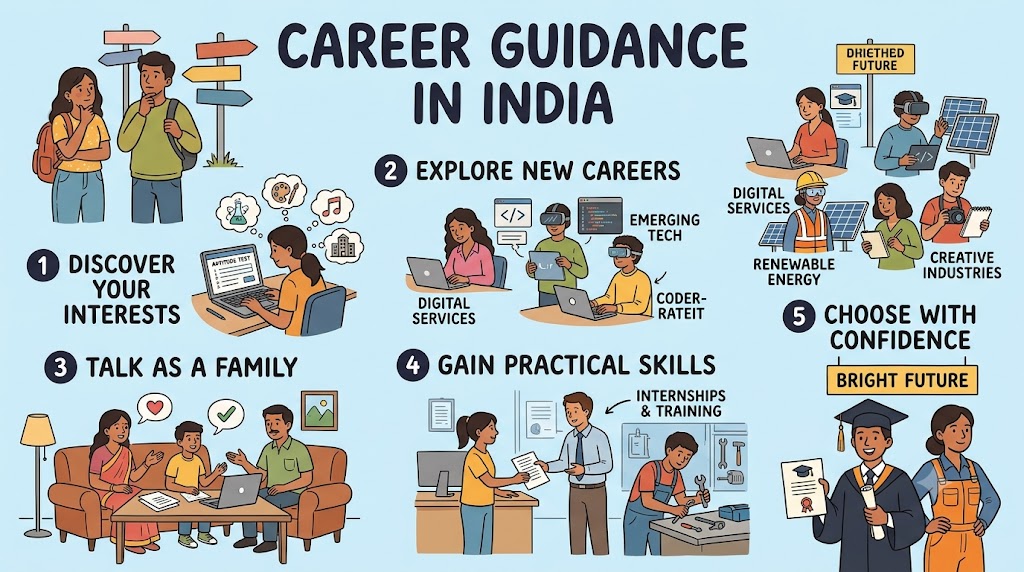
Choosing a career has become one of the most important and challenging decisions facing young people in India. At a time when education is increasingly linked to employment prospects, students are expected to decide what they want to study and what they hope to become, often before they have had enough opportunities to understand their own interests and abilities.
For many families, the conversation begins with familiar options such as engineering, medicine, government employment or business. These paths can offer rewarding opportunities, but they do not represent the full range of possibilities available to today's students. Creative industries, digital services, healthcare technology, renewable energy, skilled trades and emerging technology-related professions are also reshaping the employment landscape.
Yet many students continue to make decisions under pressure. Some follow the expectations of their parents, others choose courses because their friends are pursuing them, while many rely on examination results to determine what they should do next. The result can be a mismatch between a student's abilities, personal interests and chosen profession.
This is where career guidance in India assumes greater importance. Effective counselling can help students look beyond marks and social expectations, understand the realities of different professions and choose an educational path that reflects both their ambitions and practical circumstances.
Why Students Need More Than Academic Advice
Academic performance remains important for college admissions and many professional courses. However, marks alone cannot determine whether a student will find a particular career satisfying or develop the skills needed to succeed in it.
A student who performs well in science may have several options beyond medicine or engineering. Similarly, someone with strong communication skills might explore teaching, journalism, marketing or public relations. Students who enjoy practical work may find opportunities through technical training, apprenticeships and vocational education.
Without proper guidance, these possibilities can remain unexplored. Students may select a course without understanding its curriculum, the cost of completing it, the skills it demands or the employment opportunities it offers.
Career counselling can help bridge this information gap. Through individual discussions, interest assessments, aptitude tests and exposure to different professions, students can develop a clearer understanding of their strengths and preferences.
Such assessments should be treated as useful starting points rather than final judgments about a student's future. A meaningful career decision also requires research, practical experience and an honest evaluation of available opportunities.
Family Expectations and the Pressure to Choose a Secure Career
In India, career decisions often involve the entire family. Parents invest heavily in their children's education and naturally want them to find stable employment, financial independence and a secure future.
These concerns are understandable, particularly when education involves expensive coaching, tuition fees and years of preparation. However, the search for security can sometimes lead families to favour a narrow selection of careers, even when their children have different interests.
A student interested in design, writing, sports or social sciences may feel compelled to pursue a conventional professional degree. Another may continue preparing for a competitive examination because changing direction is seen as a sign of failure.
Such situations highlight the need for more open conversations between parents and students. Families should discuss financial limitations and employment prospects while also considering the student's abilities, motivation and long-term goals.
The purpose of career guidance is not to dismiss parental advice. It is to help families make informed decisions together, weighing personal interests against the realities of education costs, training requirements and job opportunities.
The Education-to-Employment Gap
One of the biggest challenges facing young people is the transition from education to employment. Completing a degree is an important achievement, but qualifications do not always provide all the practical skills required in the workplace.
Employers may look for communication skills, teamwork, analytical thinking, digital literacy and the ability to solve real-world problems. Students who have limited opportunities for practical learning may struggle to demonstrate these abilities when they begin searching for work.
This makes career planning an important part of education rather than a decision that should be postponed until graduation.
Internships, industry projects, apprenticeships and workplace visits can help students understand what different jobs involve. These experiences also allow them to assess whether a profession matches their expectations before investing years in a particular course.
Educational institutions can strengthen this process by improving career counselling, building relationships with employers and offering practical learning opportunities. Students should be encouraged to examine course content, training quality and employment pathways instead of choosing an institution based on reputation alone.
Better career guidance cannot eliminate unemployment or guarantee a job, but it can help students make more realistic decisions about the qualifications and skills they need.
Emerging Industries Are Expanding Career Opportunities
India's changing economy is creating new possibilities across technology, healthcare, manufacturing, clean energy and digital services. Artificial intelligence, cybersecurity, data analytics and cloud computing are attracting attention, while logistics, environmental management, healthcare support and technical occupations offer additional career routes.
However, the popularity of an industry should not be the only factor influencing a student's decision. Emerging fields may require specialised training, continuous upskilling and practical experience. Job availability and salaries can also vary considerably according to location, employer and individual capability.
Students therefore need career information that explains both the opportunities and the demands of a profession.
Someone interested in technology should understand the relevant qualifications and technical skills. A student considering healthcare should explore the different educational routes, licensing requirements where applicable and the responsibilities associated with each role. Those interested in renewable energy or sustainability should investigate the technical, scientific and business skills required in these areas.
The objective is to help students distinguish between a career that is simply receiving attention and one that genuinely suits their interests and capabilities.
Making Career Guidance Accessible Beyond Major Cities
Access to career counselling is not equal for all students. Young people in smaller towns and rural areas may have fewer opportunities to interact with professionals, visit workplaces or receive advice from trained counsellors.
Financial constraints can further limit their choices. Some students may be unaware of scholarships, affordable courses, vocational programmes or apprenticeships that could help them develop employable skills without taking on substantial education costs.
Digital platforms can make career information more accessible, but online resources alone may not be sufficient. Students may need guidance in their preferred language, help evaluating the credibility of training providers and support in understanding admission or eligibility requirements.
Schools, colleges and public institutions can help by organising career workshops, inviting professionals to speak with students and sharing information about education and training pathways. Counselling should include vocational and technical careers alongside conventional university routes.
A student's location or family income should not determine whether they have access to reliable information about their future.
Why Career Planning Should Begin Early
Career decisions often become urgent during Classes 10 and 12, when students must select subjects, prepare for entrance examinations or apply to colleges. By then, some may have spent years studying without exploring which professions align with their interests.
Introducing career awareness earlier gives students more time to understand their options. Schools can arrange career discussions, aptitude-awareness activities, workplace visits and interactions with professionals before major academic decisions arise.
Students can also take practical steps independently. They can research course requirements, speak to people working in fields that interest them, attend introductory workshops or undertake small projects to test their preferences.
These activities help students move beyond assumptions and gain a clearer understanding of what different careers involve.
Career planning should also remain flexible. Interests change, industries evolve and personal circumstances develop over time. Students should be able to reconsider their choices without feeling that a change of direction represents failure.
The goal is not to make a perfect decision at an early age. It is to build the confidence and knowledge needed to make better decisions at every stage of life.
Building a Stronger Career Guidance System
Improving career guidance in India requires cooperation among schools, families, colleges, counsellors and employers.
Schools need trained counsellors and updated information about educational pathways. Colleges should strengthen internships, practical learning and career support. Employers can contribute by explaining the skills required in different professions and offering opportunities for workplace exposure.
Parents can help by encouraging honest discussions about interests, abilities and financial realities. Counsellors should provide balanced advice based on a student's circumstances rather than promoting particular courses or promising guaranteed employment.
Technology can support this process through online career information, assessments and counselling sessions. However, digital tools are most effective when combined with informed human guidance and opportunities to experience the world of work.
Career guidance should also be viewed as an ongoing service rather than a one-time consultation. Students may need different kinds of support when choosing subjects, selecting a college, entering the workforce or considering further training.
Conclusion: Helping Students Build a Future with Confidence
Career guidance in India is about much more than choosing a college or selecting a professional course. It is about helping young people understand their strengths, evaluate their options and prepare for a world of work that continues to change.
When career decisions are driven mainly by social pressure, incomplete information or assumptions about financial security, students may overlook opportunities that better suit their abilities. Reliable counselling can help them explore a wider range of professions and understand the relationship between education, skills and employment.
No single career is right for every student, and no guidance system can guarantee professional success. But access to accurate information, practical exposure and supportive advice can make the journey less confusing and more purposeful.
India's young people need the freedom to explore different possibilities and the guidance to evaluate them realistically. By making career counselling a stronger part of the education system, the country can help students make more informed choices while building a workforce better prepared for the opportunities and challenges ahead.