
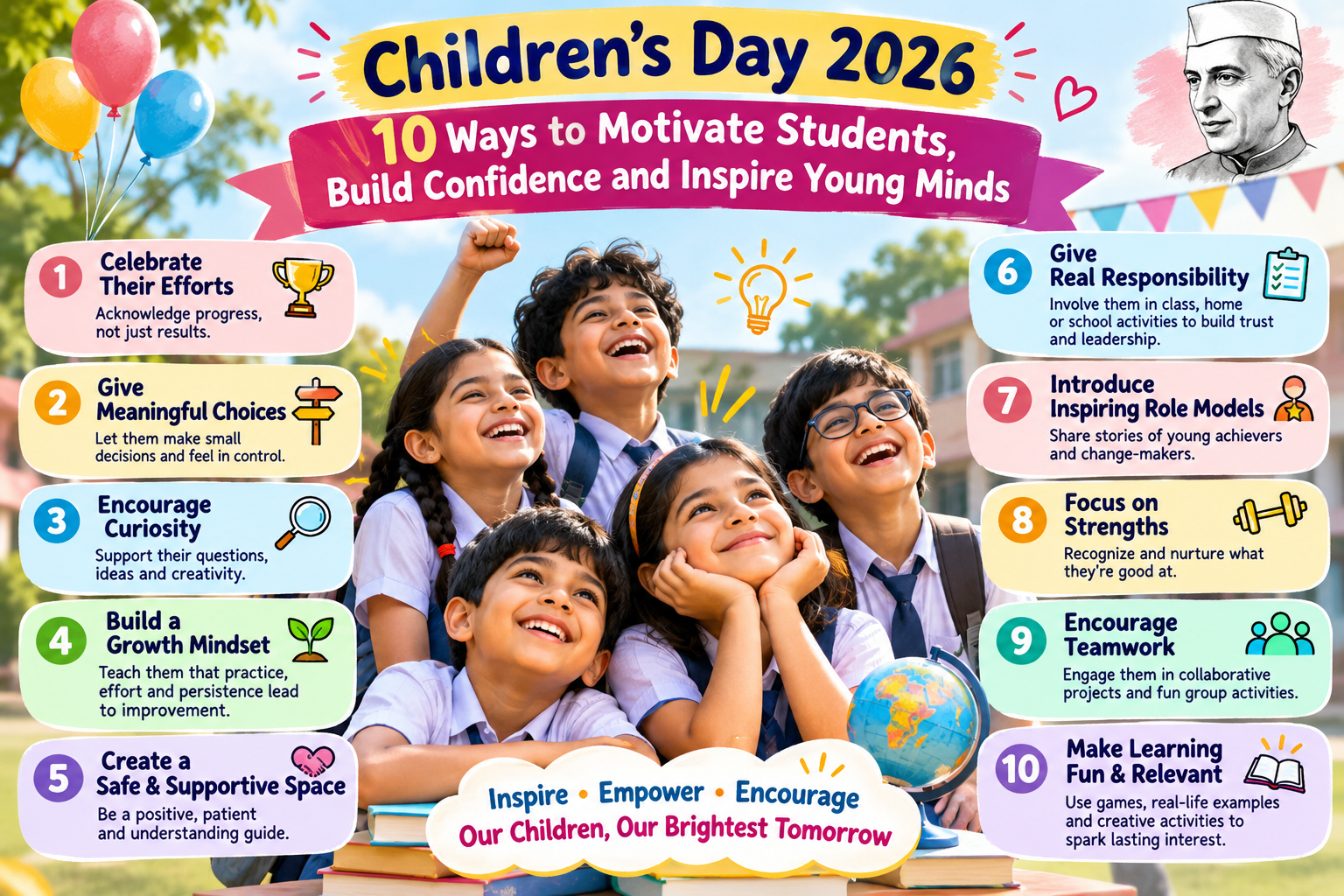
Nov 14: Children's Day is a celebration of childhood, curiosity, creativity and the endless possibilities that young minds hold. While schools mark the occasion with cultural programmes, games and special activities, the day also offers an opportunity to reflect on something much more important: how we can help children believe in themselves, discover their talents and build a brighter future.
In India, Children's Day is celebrated every year on November 14 to mark the birth anniversary of Pandit Jawaharlal Nehru, the country's first Prime Minister. Fondly known as Chacha Nehru, he had a deep affection for children and believed that their education and well-being were essential to the nation's progress.
Beyond the celebrations, Children's Day 2026 raises an important question for parents, teachers and educational institutions: Are we doing enough to encourage children to learn, explore and follow their dreams?
Every child is different. Some excel in academics, while others shine in sports, music, art, technology or creative activities. The real challenge is to recognise these abilities and provide children with the encouragement they need to grow.
As education continues to evolve, motivating students requires more than helping them achieve good examination results. It involves building confidence, developing essential life skills and creating an environment where children feel comfortable expressing themselves and exploring new opportunities.
Why Children's Day Is More Than Just a Celebration
For many students, Children's Day is one of the most enjoyable occasions at school. It brings a welcome break from regular classes and gives children an opportunity to participate in performances, competitions and fun activities.
However, the significance of the day goes much further.
It reminds us that children need more than textbooks and examination results to develop into confident individuals. They need encouragement, opportunities to express themselves and the freedom to explore their interests.
A child who struggles with mathematics may be an excellent storyteller. Another who finds it difficult to speak in front of a class may have exceptional artistic abilities. Recognising these differences is important because every child deserves the opportunity to discover what they are good at.
Children's Day is also a reminder that education should help students develop into responsible, independent and compassionate individuals who can contribute positively to society.
How Can We Motivate Students?
Students can be motivated by recognising their efforts, encouraging curiosity, setting achievable goals, making learning interactive and providing a supportive environment. Parents and teachers should focus on individual progress rather than comparisons, celebrate small achievements and give children opportunities to explore their interests. Encouragement, emotional support and positive learning experiences can help students develop confidence and a lasting interest in education.
10 Effective Ways to Motivate Students and Build Confidence
Motivating students does not always require expensive programmes or elaborate teaching methods. Often, a few thoughtful changes in the classroom and at home can make a significant difference.
1. Appreciate Effort, Not Just Examination Results
One of the biggest mistakes in education is judging a child's abilities only through marks and grades.
While academic performance matters, students also need recognition for their effort, improvement and willingness to learn. A child who has improved from scoring 40 to 60 marks deserves encouragement just as much as a student who consistently scores above 90.
Teachers and parents should acknowledge progress rather than constantly comparing children with others.
A simple appreciation such as "You have improved a lot" or "I can see how much effort you have put into this" can give a student the confidence to keep trying.
2. Encourage Children to Ask Questions
Children are naturally curious. They want to know why things happen, how things work and what they can discover around them.
Unfortunately, some students hesitate to ask questions because they fear giving the wrong answer or being laughed at by classmates.
Teachers can change this by creating classrooms where questions are welcomed and mistakes are treated as part of learning.
Instead of focusing only on completing the syllabus, educators should encourage discussions, experiments and activities that allow students to think independently.
Sometimes, one interesting question can inspire a child to explore an entirely new subject.
3. Make Learning Fun and Practical
Not every lesson needs to begin and end with a textbook.
Children often understand concepts better when they can see, experience or participate in what they are learning.
Science experiments, storytelling, educational games, quizzes, group projects and classroom demonstrations can make lessons more interesting.
For example, students learning about environmental conservation can participate in a tree-planting activity. Mathematics can become more engaging through simple budgeting exercises or classroom shopping games.
When children enjoy the learning process, they are more likely to develop a genuine interest in education.
4. Teach Children That Making Mistakes Is Okay
Fear of failure can prevent students from trying new things.
Some children avoid participating in competitions because they are afraid of losing. Others hesitate to answer questions because they do not want to make mistakes.
Parents and teachers need to help children understand that mistakes are not signs of weakness. They are opportunities to learn and improve.
Rather than criticising a child for getting something wrong, encourage them to understand the mistake and try again.
This approach helps children develop resilience, patience and the confidence to face unfamiliar challenges.
5. Help Students Discover Their Talents
Not every child dreams of becoming a doctor, engineer or government officer. Some may want to become musicians, athletes, designers, writers, entrepreneurs or scientists.
Schools should give students opportunities to explore different interests through sports, art, music, theatre, public speaking, robotics and other extracurricular activities.
Parents can also encourage children to try new hobbies without putting pressure on them to become experts immediately.
Discovering an interest at an early age can give children a sense of purpose and help them understand their own strengths.
6. Set Small and Achievable Goals
Big ambitions are exciting, but they can sometimes feel overwhelming for young students.
Teachers and parents can help by encouraging children to set small, realistic goals.
A student who wants to improve English can begin by reading a few pages every day. Someone who struggles with mathematics can practise a few additional problems regularly.
Every small achievement creates a sense of progress.
Over time, children begin to understand that success is not always about one major achievement. It is often the result of consistent effort and patience.
7. Introduce Children to Inspiring Stories and Role Models
Stories have a special way of influencing young minds.
Reading about scientists, sportspersons, entrepreneurs, artists and other inspiring personalities can help children understand that success often comes after years of hard work and determination.
Parents and teachers can also share stories of ordinary people who overcame difficulties to achieve their goals.
It is equally important to remind children that they do not have to become famous to make a difference. Being kind, responsible, creative and helpful are achievements worth celebrating too.
8. Create a Classroom Where Every Child Feels Included
A student's confidence is closely connected to how comfortable they feel in their learning environment.
Children who are constantly criticised, ignored or compared with their classmates may gradually lose interest in participating.
Teachers should make an effort to involve quieter students, listen to different opinions and ensure that no child feels left out.
Group activities, classroom discussions and collaborative assignments can help students build friendships and learn to work with others.
A classroom where children feel safe and respected can make learning a much more rewarding experience.
9. Use Technology to Encourage Learning
Today's students are growing up in a world where technology is becoming part of everyday life.
Educational applications, interactive videos, online learning platforms and artificial intelligence tools can make it easier for children to explore subjects beyond their school curriculum.
For instance, students can use digital resources to understand scientific concepts, learn basic coding or practise a new language.
However, technology should be used thoughtfully. Parents and teachers need to guide children towards reliable, age-appropriate resources and ensure that screen time does not replace outdoor activities, reading and face-to-face interaction.
The aim should be to make technology a useful learning companion rather than a distraction.
10. Give Children Time, Attention and Emotional Support
Sometimes, what a student needs most is not another lesson or an additional assignment but someone willing to listen.
Academic pressure, friendship problems and fear of disappointing parents can affect a child's confidence and interest in studies.
Parents should make time to talk to their children about their day, listen to their concerns and understand what they are experiencing.
Teachers, too, can make a difference by recognising when a student needs additional support.
Children who feel understood and supported are more likely to develop confidence and approach challenges with a positive attitude.
The Importance of Emotional Intelligence and Life Skills in Education
Academic knowledge is important, but children also need to understand their emotions, communicate effectively and develop healthy relationships.
Emotional intelligence helps students recognise their feelings, understand the perspectives of others and respond thoughtfully to challenging situations.
Similarly, essential life skills such as decision-making, problem-solving, teamwork, time management and adaptability prepare children for situations they may encounter outside the classroom.
Schools can encourage these abilities through group assignments, sports, classroom responsibilities, creative activities and community participation.
For example, working on a group project teaches children how to share ideas, listen to different opinions and cooperate towards a common goal. Participating in sports helps them understand teamwork, discipline and the importance of handling both victories and setbacks.
These experiences help students develop qualities that are valuable throughout their lives.
How India's National Education Policy 2020 Encourages Holistic Student Development
India's National Education Policy (NEP) 2020 places considerable emphasis on moving beyond rote learning and creating an education system that supports the overall development of students.
The policy highlights critical thinking, creativity, experiential learning, problem-solving and the development of essential 21st-century skills.
It also encourages interactive classroom experiences, including hands-on activities, sports-integrated learning, arts-based education and opportunities for students to explore subjects through practical experiences.
This approach is important because children learn in different ways. Some understand concepts through reading, while others learn better through demonstrations, discussions and practical activities.
The emphasis on holistic education also reinforces the need to recognise individual abilities and provide students with opportunities to develop both academic and non-academic interests.
For parents and teachers, the broader message is clear: education should not simply prepare children to pass examinations. It should help them become confident, capable and independent individuals.
The Role of Parents and Teachers in Motivating Students
A child's development is influenced by the people and environment around them. Parents and teachers, in particular, play an important role in shaping how children view themselves and their abilities.
Parents are often a child's first teachers. The way they respond to questions, mistakes and achievements can influence a child's confidence for years to come.
Similarly, teachers have the opportunity to make learning an enjoyable experience. A teacher who takes the time to understand a student's difficulties or encourage a hidden talent can leave a lasting impression.
The relationship between parents and teachers should therefore go beyond discussing examination results. Regular communication about a child's interests, behaviour, progress and challenges can help provide better support.
Most importantly, children should be allowed to grow at their own pace. Constant comparisons and unrealistic expectations can create unnecessary pressure and prevent them from enjoying the learning process.
Preparing Students for a Changing Future
The world children are growing up in is changing rapidly. Artificial intelligence, automation, digital businesses and emerging technologies are influencing the skills required across different professions.
While academic knowledge will continue to be important, students will also need creativity, communication, adaptability, teamwork and problem-solving abilities.
Schools should introduce activities that encourage children to think independently and find solutions rather than simply memorise information.
At the same time, values such as empathy, honesty, responsibility and respect for others should remain central to education.
Preparing children for the future is not about making them compete with everyone around them. It is about helping them become capable individuals who can adapt, make informed decisions and contribute positively to society.
Children's Day 2026: A Reminder to Let Children Dream
Children's Day is a reminder that every child deserves an opportunity to learn, grow and dream without being restricted by unrealistic expectations.
A student who does not perform well in one examination should not be made to feel that their future is limited. A child who chooses a creative career should receive encouragement just as much as one who chooses a conventional profession.
Education should help children discover their interests rather than force them into a predetermined definition of success.
This November 14, schools and families can make Children's Day more meaningful by going beyond celebrations and starting conversations about confidence, kindness, creativity and the importance of learning.
The most meaningful gift adults can give children is an environment where they feel heard, respected and encouraged to explore their potential.
Conclusion
Children do not always remember the marks they scored in school, but they often remember the teachers who encouraged them, the parents who believed in them and the moments when someone made them feel capable of achieving something meaningful.
That is what makes student motivation so important.
Children's Day 2026 is an opportunity to reflect on how we nurture the next generation. Motivating students begins with simple actions: appreciating their efforts, encouraging curiosity, supporting their interests and helping them learn from their mistakes.
Every child has a different strength, a different dream and a different journey. Our responsibility is to give them the confidence and opportunities to discover what they can achieve.
This Children's Day, let us encourage children to ask questions, explore their interests, embrace challenges and pursue their dreams with confidence.
Because sometimes, all it takes to change a child's future is one encouraging word, one opportunity or one person who believes in their potential.