
Bodh Gaya, November 21, 2026
The Indian Institute of Management (IIM) Bodh Gaya hosted Buddhonomics 2026, an international conference bringing together academicians, policymakers, researchers and industry leaders to examine the relevance of Buddhist philosophy in contemporary economic systems. Centred on the theme “Partnering for Prosperity, Posterity and Peace,” the conference explored the connections between economic prosperity, ethical conduct, mindfulness and sustainability.
The event commenced with the ceremonial lighting of the lamp. Prof. Vinita S. Sahay, Director, IIM Bodh Gaya, spoke about the institute's connection with its geographical and cultural surroundings, remarking, “This is the soil, definitely not ordinary.” She discussed the role of education and skill development in unlocking local potential and fostering inclusive growth. She also reaffirmed mindfulness and sustainability as the institute's guiding values and highlighted the importance of academic platforms in facilitating knowledge exchange and collaboration.
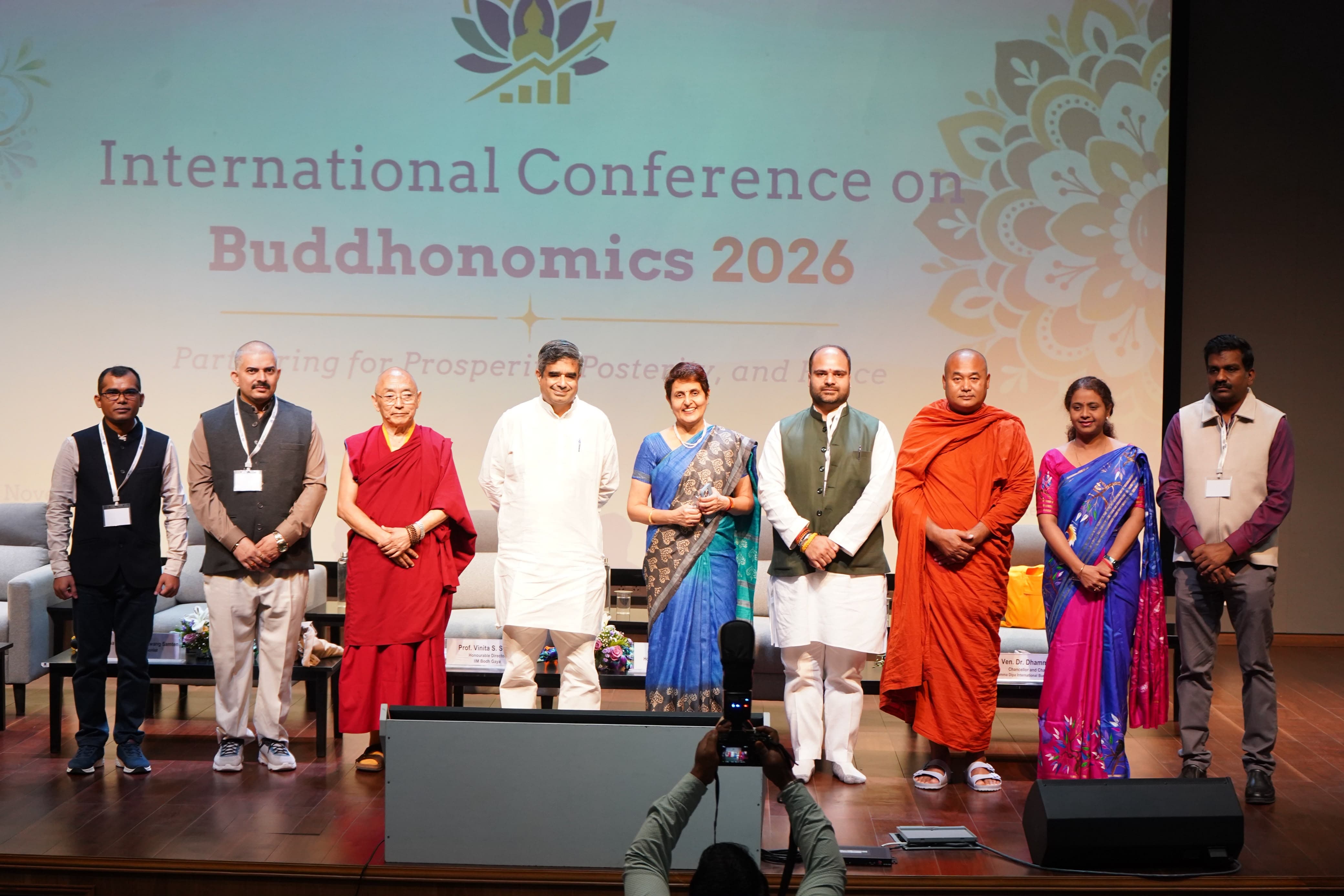
Shri Saket Mishra, Member of the Legislative Council (MLC), Uttar Pradesh, and former Indian Police Service (IPS) officer, attended the conference as the Chief Guest. In his address, he spoke about the need for a moral foundation in economic activity. He noted that Buddhism does not oppose wealth creation but advocates ethical means of pursuing it through the principle of Right Livelihood. Drawing attention to the concentration of wealth and technological power, he advocated treating artificial intelligence as a global commons, ensuring that its benefits extend beyond a few entities. He also called for preserving human agency and accountability in AI-driven decision-making.
Prof. Aviral Kumar Tiwari, Dean, Research and Planning, IIM Bodh Gaya, explained the relationship between economic well-being and ethical conduct. Raising the question of whether an economy can be both prosperous and wise, he explained that wealth creation must go hand in hand with virtue and responsibility. Referring to the traditional concept of Shubh-Labh, he noted that economic progress must extend beyond material gains and contribute to collective well-being.
Reflecting on India's intellectual and philosophical heritage, Padma Shri awardee Prof. Geshe Ngawang Samten, a distinguished Tibetan educationist, spoke about the legacy of Nalanda and India's contribution to global knowledge. He drew attention to the relationship between happiness and human well-being, highlighting the importance of understanding the mind. He further discussed how equality begins with individual transformation, compassion and loving-kindness, advocating economic systems guided by ethics, human welfare and sustainability.
Dr. Dhammapiya, Chancellor and Chairman, DDIBU, spoke about how the Buddha's teachings extend beyond the management of money and resources to the management of life itself. Drawing an analogy with a honeybee that collects nectar without harming the flower, he explained the importance of responsible resource utilisation and maintaining a balance between individual, societal and environmental well-being. He also advocated mindful consumption and individual transformation, while proposing an International Buddhonomics Forum to take this vision forward through global collaboration.
The conference received 272 research paper submissions, of which 207 were accepted following review. A total of 140 papers were scheduled for presentation across 25 technical tracks covering seven themes, with 59 presentations planned in person and the remainder online. Discussions covered areas such as the global economic order, sustainable development, governance, responsible business, artificial intelligence and cultural heritage.
The event brought together 96 organisations from 11 countries, including the United Kingdom, France, Spain, Italy, Thailand, Argentina, Nepal, Vietnam, Bhutan and Sri Lanka. Indian academic representation included 12 IIMs, IITs and national institutes, 45 universities, and 26 business schools and colleges. Seven industry and civil society organisations, including Tata Steel and Bank of Baroda, also participated.
Buddhonomics 2026 brought attention to the relevance of integrating ethical responsibility, compassion and sustainability into contemporary economic thought. Through this initiative, IIM Bodh Gaya seeks to encourage dialogue between ancient Indian wisdom and modern economic challenges, fostering interdisciplinary research and collaborative approaches towards a more inclusive and sustainable future.