
A major national dialogue on sustainable technology, innovation and India’s green growth journey began at Manipal University Jaipur (MUJ) with the inauguration of the International Conference on Advanced Sustainable Technologies (ICAST-2026). Organised by the Department of Biotechnology and Chemical Engineering, MUJ, with the Indian Chemical Council (ICC) as industry partner, the three-day international conference is being held from August 19 to 21, 2026.
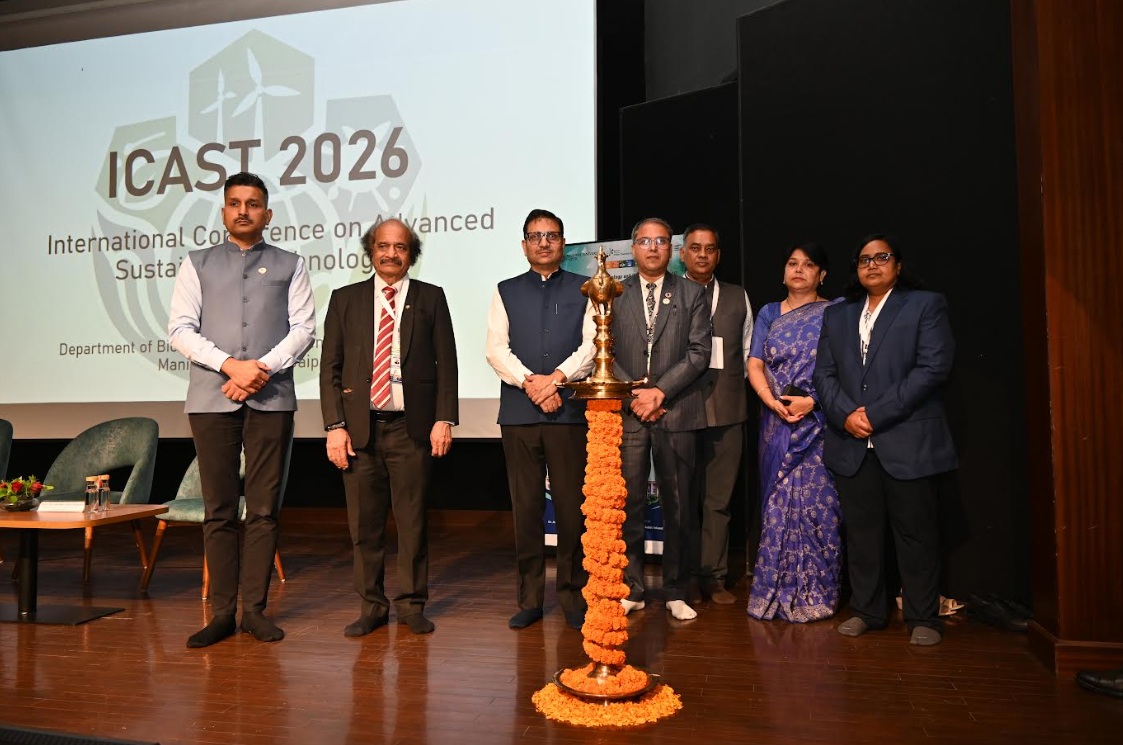 |
Dignitaries present at the ICAST 2026 inaugural session
Sponsored by the Anusandhan National Research Foundation (ANRF), ICAST-2026 has brought together around 250 participants and 18 keynote and invited speakers from academia and industry from India and across the world. The conference provides a significant platform for deliberations on translating emerging technologies and scientific research into scalable solutions to India’s environmental, industrial and developmental challenges.
The inaugural ceremony was graced by Shri V. Srinivas, Chief Secretary, Government of Rajasthan, as the Chief Guest. Padma Shri Prof. G. D. Yadav, Emeritus Professor of Eminence and Former Vice Chancellor, Institute of Chemical Technology (ICT), Mumbai, was the Guest of Honour, while Prof. N. N. Sharma, President, Manipal University Jaipur, presided over the ceremony. Dr. Amit Soni, Registrar; Dr. Nitu Bhatnagar, Provost; Dr. Kuldip Singh Sangwan, Dean, Faculty of Science, Technology & Architecture; and Dr. Ravi Kant Gupta, Associate Dean, were also present.
Addressing the gathering in the virtual mode, Shri V. Srinivas stressed the need to move beyond the conventional choice between development and sustainability. He emphasised that the goal must be to achieve development through sustainability, supported by scientific knowledge, technological feasibility, strong institutions and social responsibility.
Drawing upon his academic background as a Chemical Engineer, Shri Srinivas identified green hydrogen, sustainable energy, critical minerals, advanced energy storage and recycling, environmental remediation, circular economy, sustainable materials, biotechnology, artificial intelligence and digital technologies as critical areas that will shape India’s technological future.
He also highlighted Rajasthan’s immense potential in renewable energy, green hydrogen and sustainable industrial development in line with the State’s vision of Viksit Rajasthan 2047. Calling for deeper collaboration among academia, industry, government, entrepreneurs and young innovators, he emphasised the need to develop solutions to pressing challenges related to water, energy, waste, agriculture and climate resilience.
Padma Shri Prof. G. D. Yadav, in his inspiring address, highlighted the expanding role of Chemical Engineering in the era of sustainability and technological transformation. He said the discipline has moved well beyond conventional chemical industries and now has a crucial role in green chemistry, renewable energy, green hydrogen, advanced materials, biotechnology, energy transition, circular economy and sustainable manufacturing.
Encouraging young researchers and students to embrace interdisciplinary research and emerging technologies, Prof. Yadav underlined the role of Chemical Engineering in connecting science, engineering, industrial applications and sustainability. His message, “Pause, Ponder and Proceed,” urged researchers to understand problems deeply before developing solutions. He also shared his three-pronged philosophy, “Patent, Publish and Prosper,” calling upon researchers to convert knowledge into intellectual property, high-quality publications, innovation and societal impact.
In his Presidential Address, Prof. N. N. Sharma emphasised that challenges such as climate change, resource depletion, environmental degradation and energy security cannot be addressed within traditional disciplinary boundaries. He highlighted the convergence of engineering, biotechnology, materials science, environmental sciences, artificial intelligence and digital technologies as a powerful pathway towards sustainable development.
Prof. Sharma reiterated MUJ’s commitment to building an ecosystem where knowledge is transformed into innovation, innovation into technology, and technology into meaningful societal impact. He also stressed the importance of strengthening academia–industry partnerships to accelerate the translation of research from laboratories into real-world applications.
ICAST-2026 comes at a crucial juncture as India accelerates its transition towards green growth, energy security, circular economy, advanced manufacturing and technology-driven sustainable development. Through interdisciplinary research, expert dialogue and stronger academia–industry–government collaboration, the conference seeks to strengthen research networks and advance innovative solutions for a greener, more resilient and sustainable India.
To know more about Manipal University Jaipur, please visit the official website of Manipal University Jaipur: jaipur.manipal.edu