
New Delhi, Oct 28: Union Electronics and Information Technology Minister Ashwini Vaishnaw has defended the government’s Production Linked Incentive (PLI) scheme for mobile phone manufacturing, citing significant tax collections and employment generation in response to a Bloomberg analysis questioning the economic benefits of India’s electronics manufacturing strategy.
Representational Image
In a post on social media platform X on Wednesday, Vaishnaw highlighted the financial contributions of the mobile manufacturing sector, arguing that the incentives provided by the government have been accompanied by substantial revenue generation and job creation.
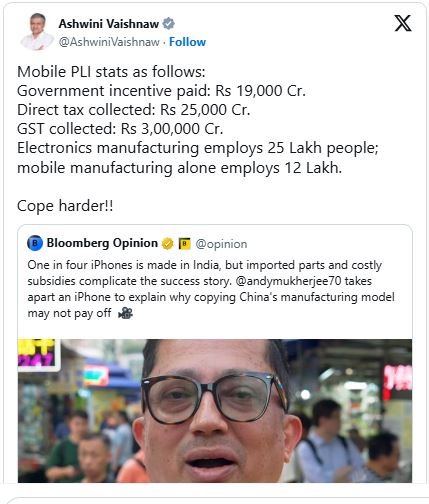
Mobile PLI stats as follows: Government incentive paid: Rs 19,000 Cr. Direct tax collected: Rs 25,000 Cr. GST collected: Rs 3,00,000 Cr. Electronics manufacturing employs 25 Lakh people; mobile manufacturing alone employs 12 Lakh. Cope harder!!
— Ashwini Vaishnaw (@AshwiniVaishnaw) October 27, 2026
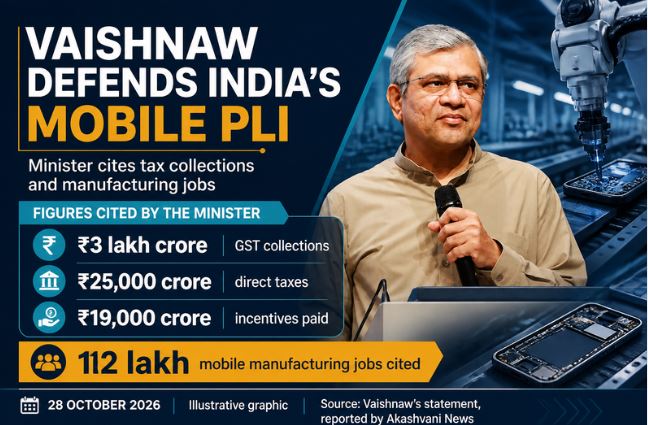
According to figures shared by the minister, the government has disbursed ₹19,000 crore in incentives under the mobile PLI scheme. Meanwhile, direct tax collections from the sector have reached ₹25,000 crore, while Goods and Services Tax (GST) collections have totalled ₹3 lakh crore.
The minister also pointed to the sector’s employment contribution, stating that electronics manufacturing supports approximately 25 lakh jobs across India, including nearly 12 lakh jobs in mobile phone manufacturing alone.
Bloomberg Analysis Questions Economic Returns
Vaishnaw’s remarks came in response to a Bloomberg analysis examining whether India’s efforts to establish itself as a major electronics manufacturing hub can replicate China’s success and deliver broader economic benefits.
The analysis acknowledged India’s growing role in smartphone production, including the manufacturing of Apple’s iPhones, but raised concerns about the country’s continued dependence on imported components.
Key components such as processors, memory chips, batteries and camera lenses are still sourced substantially from overseas suppliers, limiting the extent of domestic value addition in some parts of the manufacturing chain.
The report also questioned whether government subsidies under the PLI programme adequately offset the costs of attracting manufacturers and establishing competitive production operations in India.
India’s Electronics Manufacturing Push
The PLI scheme is designed to encourage domestic manufacturing, attract investment, expand production and strengthen India’s position in global supply chains through financial incentives linked to performance.
India has emerged as an increasingly important production base for smartphones, with a growing share of global iPhone manufacturing shifting to the country. However, the extent to which this expansion translates into domestic component manufacturing and deeper local value addition remains a key issue in assessing the sector’s long-term economic impact.
The figures cited by Vaishnaw underline the government’s case that the programme has generated significant fiscal contributions and employment opportunities. At the same time, the debate highlights the challenge of moving beyond final assembly towards a more comprehensive domestic electronics ecosystem.
The long-term success of India’s manufacturing strategy will depend not only on production growth and job creation but also on strengthening local component supply chains, expanding technological capabilities and increasing value addition within the country.